Insurance broking / Productivity
Productivity improvement strategies in insurance broker firms: seven considerations
Insurance broker firms can improve productivity by reducing the administrative work that surrounds advice. This means making client data easier to access, capturing information once instead of repeatedly, reducing the manual handling of carrier documents, preparing product comparisons more efficiently, and giving advisers fewer systems to work across.
The focus should not be on making advisers work faster. It should be on understanding where their time goes.
A single client relationship generates information across meetings, client records, policy documents, carrier illustrations, application forms, servicing requests and claims. Most of this information already exists somewhere within the firm. The time goes into finding it, working out what it means, comparing it, and typing it somewhere else.
Which work currently requires an adviser's time but does not require an adviser's judgement?
Seven areas are worth examining against that question.
01Make client information easier to find
Consider a client call. The client asks what was discussed at their last review. The answer is likely somewhere within meeting notes, emails, policy documents or servicing records.
This is a retrieval problem rather than a recordkeeping problem. The longer a client relationship runs, the more information attaches to it. Even a firm with a good filing system may still require an adviser to search across several systems to answer one question.
AI-assisted search can change how an adviser reaches that information. Rather than going through each record one by one, the adviser asks a question directly.
- What did we discuss at the client's last review?
- Which policies does the client hold now?
- What servicing matters are outstanding?
- When was the client's insurance coverage last reviewed?
There is a big difference between finding information and knowing where it came from. A system used for financial advice should provide the records behind its answers. A good answer with no supporting source may save time now and create problems later.
A better search system is not just about how quickly you can find something. It is about how quickly you can find something you can rely on.
02Capture client conversations
Some of the most important facts about a client are first discussed verbally, not entered into a database.
In one conversation, a client may discuss a change in their family situation, financial priorities, existing insurance, a medical issue or a concern about a policy. Decisions may be made and actions agreed. The adviser has to focus on the conversation and then make sure the important points reach the client's file. That second job often lands at the end of the day.
Speech recognition can turn a recorded conversation into text. AI can then organise the transcript around the main topics discussed, decisions made and actions to follow up.
The transcript itself is not necessarily the useful part. An hour-long conversation can become pages of text that the adviser still has to read.
The practical value is in giving that information some structure. The adviser can check it, correct it and add the relevant information to the client record. It also means a conversation from six months ago becomes easier to find when it matters.
Recording client conversations raises consent and privacy questions before it raises technical ones. The firm needs a way to inform clients, obtain consent where required, control who can access recordings and decide how long recordings should be kept.
Meeting automation should be designed around these requirements rather than having them fitted around the technology afterwards.
03Don't enter data that the firm already has
Repeated data entry is one of the clearest places to find work that should not exist.
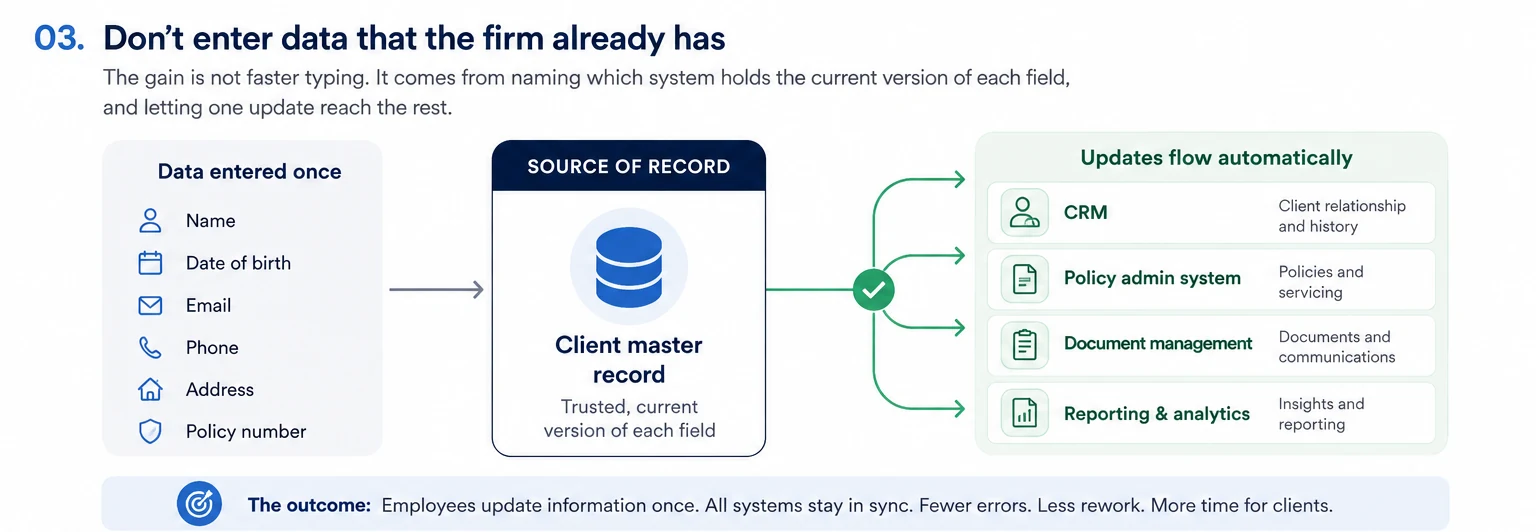
The firm already has the client's name, date of birth, contact information, address and policy numbers. Employees may then type some of those details again to prepare an application, update a record or handle a servicing request. Every repetition costs time and creates another chance for two systems to disagree.
The principle is simple: enter information once and reuse it where appropriate.
Doing this properly takes more than copying information between screens. The firm has to determine which system is the trusted source for each piece of client data and how an update reaches the other systems that need it.
When a client changes their address, no employee should have to work out which of the firm's systems contains the current address.
Scroll to see the full diagram →
The productivity gain comes once the firm solves that records problem.
04Make insurance illustration comparison more efficient
Illustration comparison is a different type of problem.
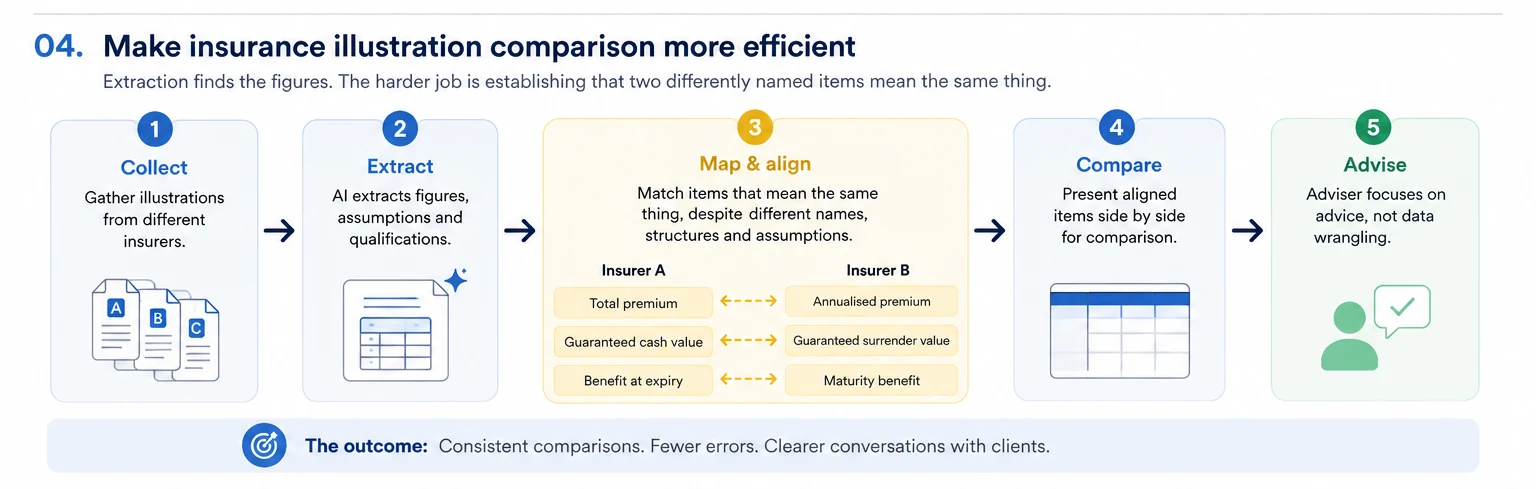
The difficulty is not simply extracting numbers from a PDF. Insurers use different terminology, document structures and assumptions. Guaranteed and non-guaranteed values may appear differently, and a qualification that changes what a figure means may sit in a table, in an accompanying explanation or in a footnote.
This leaves the adviser with two jobs: find the figures, then decide whether figures from two different documents actually describe the same thing.
Scroll to see the full diagram →
Extraction technology can handle much of the mechanical work. AI can assist with matching information across documents that use different structures and terminology. Values can then be organised around common concepts such as premiums, surrender values, death benefits, guaranteed values and non-guaranteed values. This gives the adviser a more consistent starting point.
The objective is not for software to choose the product. Features, assumptions, client circumstances and suitability still require professional judgement.
Clarity is also important when there is uncertainty. If a system cannot establish whether two values describe the same thing, it should say so and leave the decision with the adviser rather than quietly making the comparison.
The goal is to reduce the work needed to prepare the comparison, not remove the judgement that follows.
05Deal better with documents the firm does not control
Reducing internal data entry is one problem. Documents from outside the firm are another.
An insurance broker firm does not control the structure of a carrier's form. Different insurers ask for similar information in different ways, layouts and formats. Some documents have fillable fields. Others arrive as flat PDFs or scans, where the fields are visible to a person but do not contain the structured field information that conventional form-filling software relies on.
Automating these forms is harder because the firm's system has to interpret a document designed by someone else. The structure may bear little resemblance to the firm's own systems, and it can change when the carrier updates its forms.
Document processing can help identify what a form asks for and match it against information the firm already holds. The employee can then focus on what is missing and check the result rather than manually entering every known piece of information.
The benefit grows when a case involves several forms. If multiple carrier documents request the same new information, the firm should look at whether that information can be captured once and reused across the set.
This remains a separate problem from fixing the firm's own data-entry processes. The structure, terminology and format of these documents are controlled by someone else.
06Look at the adviser workspace as a whole
When solving productivity problems, firms can create new ones. One of them is the proliferation of software tools.
The client record is in the CRM. PDFs and documents sit somewhere else. Quotations happen in another application. Meeting notes may be in yet another. Servicing happens over email. Then an AI assistant arrives as one more application.
Each system can work well independently while the workflow between them remains broken.
That makes the workspace worth examining as a whole. How many systems does an adviser have to open to manage one client relationship? How many times do they have to move information between those systems? How much time do they spend looking for the right place to start?
A more connected workspace can bring client information, meetings, policies, documents, illustrations, applications and servicing workflows together. AI can then assist within the workflow rather than sitting beside it as another separate tool.
For some firms, removing this fragmentation may be worth more than automating any single task.
07Automate work without automating judgement
AI discussions can move quickly from helping employees to making decisions for them. The two should be kept separate.
AI can prepare work. Judgement should remain with the adviser.
Technology can retrieve a record, organise information, summarise a meeting, extract information from a document, prepare figures for comparison or help prepare a form. The adviser reviews the result before it goes anywhere.
That is the distinction between automation and autonomy.
Scroll to see the full diagram →
Productivity does not depend on AI making more decisions. It depends on better information reaching the people who already make them.
Governance belongs inside this conversation, not after it. Where is client data processed? What can the system access? Can an adviser verify the source of an answer? What do the logs show about what the system did? How is an uncertain result handled? Who approves information before it reaches a client or insurer?
The answers to these questions determine which types of automation a firm can actually use, particularly where personal, medical and financial information is involved.
Good automation removes repetitive work without blurring accountability.
Where should an insurance firm start?
Not by choosing a product.
Take one ordinary client case and follow it from the first meeting through fact-finding, comparison, application and servicing. Mark every point where someone:
- searches for information the firm already has
- copies information between systems
- reads a document to find a particular value
- compares documents manually
- turns a conversation into a written record
- enters the same information into several forms
- switches applications to complete one task
Then measure those activities.
If an adviser spends 30 minutes of each working day on repetitive information handling, that is roughly 10 hours a month across 20 working days. Do not carry that figure into your business case. Measure the actual time in your firm and multiply it by your own adviser and operations headcount.
For each activity that repeats, ask:
- What information is being handled, and where is it stored?
- Why does someone need to find, enter or transfer it again?
- Does this work require professional judgement?
- Does the information already exist somewhere within the firm?
- Can technology prepare part of the work while a person remains responsible for checking it?
Often, the best place to start with AI is not the most complicated use case. It is the work your team does most often.
Rethinking the insurance adviser workspace
We are looking at similar questions through Lumimory, a concept for a more integrated insurance adviser workspace.
We are exploring how client records, meetings, documents, insurance illustrations and servicing workflows could work together, and where AI could reduce repetitive information handling while keeping adviser review in place for anything that reaches a client or insurer.
This is not about replacing the adviser. It is about reducing the administrative hours that accumulate around the adviser's work.
Frequently asked questions
- How can insurance firms improve productivity?
- Start by identifying repetitive work that consumes employee time without requiring professional judgement. Common areas include searching for client information, repeated data entry, document handling, insurance illustration comparison, meeting documentation and switching between disconnected systems.
- How can AI increase productivity in insurance?
- AI is useful for work involving large amounts of unstructured information. This includes searching client records, summarising meetings, extracting information from documents and organising information for comparison. Human review remains important wherever the output affects advice, a client or a transaction.
- Can AI take over insurance advice?
- AI does not need to replace an insurance adviser for a firm to achieve productivity gains. A practical approach is to use AI for retrieval, preparation and administrative work while advisers remain responsible for professional judgement, review and client decisions.
- What is an insurance adviser workspace?
- An insurance adviser workspace brings together the information and tools an adviser needs to manage a client relationship. This can include client records, meetings, policies, documents, quotations, applications, servicing requests and claims. A connected workspace reduces the need for advisers to move repeatedly between separate applications to complete one task.
- Where should an insurance firm begin with AI?
- Start with the workflow, not the technology. Look at how employees spend their time, identify the tasks they perform most often and determine which parts genuinely require professional judgement. Then assess whether AI or other forms of automation can solve a measured operational problem. That gives the firm a reason to adopt the technology, rather than adopting the technology and then looking for a reason to use it.